The CGM for Everything: Inside the Venture Race to Build Continuous Blood Monitors
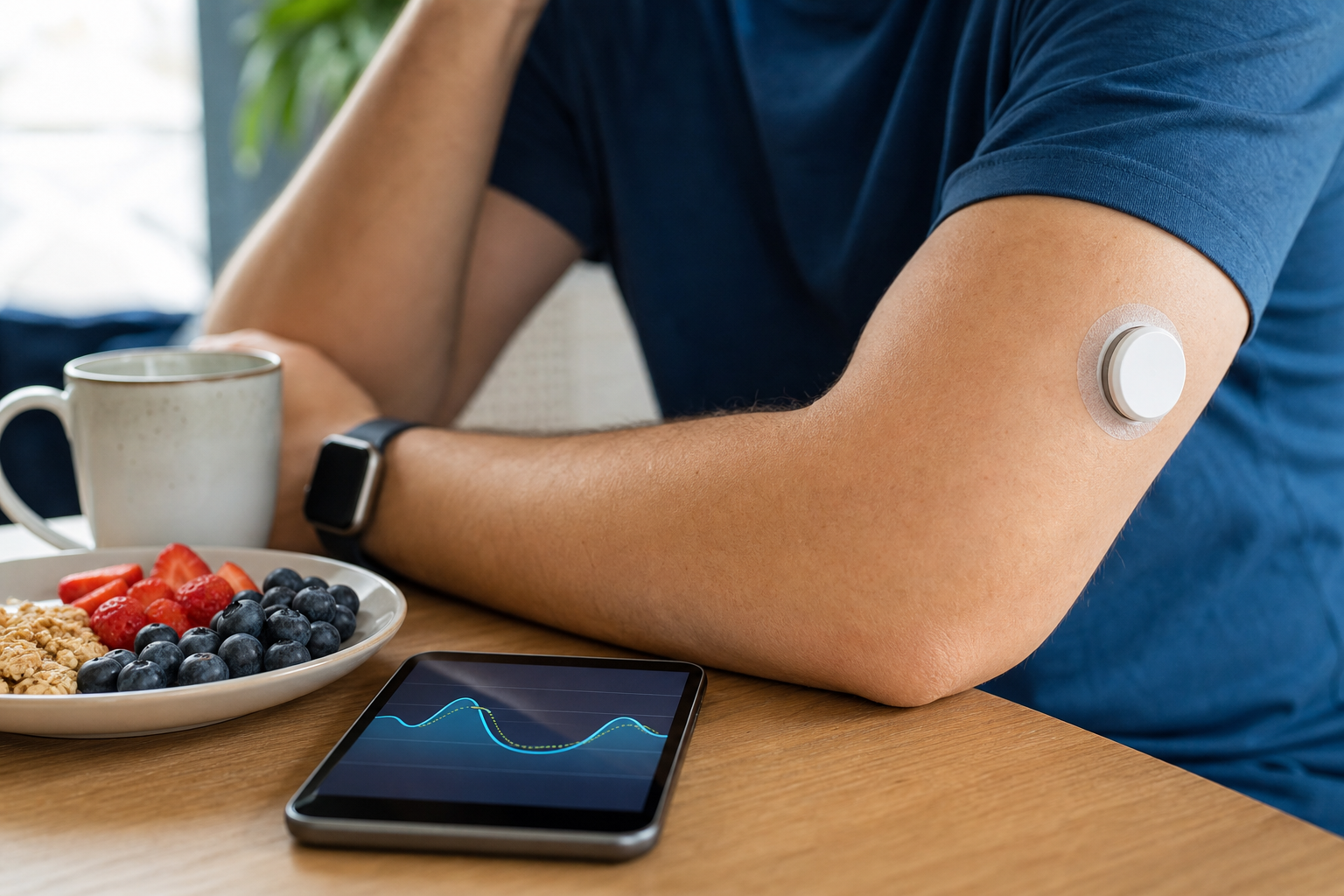
The short answer: Continuous glucose monitoring turned a single molecule into more than $12 billion of annual revenue for just two companies in 2025. A new class of startups is trying to do the same for hormones, inflammation markers and drug levels, using engineered DNA sensors, nanopores and sweat. Roughly $370 million of disclosed venture capital has gone into the eight private companies we track in this space, most of it into one company. The science is early, the regulatory path is opening and the strategic buyers are already circling. This is our map of the opportunity, the money, the risks and the role Healthcare Venture Capital Fund intends to play.
- Glucose is the proof of concept. One analyte, measured continuously, built a high-margin, double-digit growth franchise.
- The next molecules are harder. Hormones and proteins have no convenient enzyme, so the field is betting on new chemistry, and the best public human data covers about 12 hours.
- Capital is concentrated. Biolinq holds about three-quarters of disclosed funding in our tracker. Most hormone players are seed or pre-seed.
- Strategics are already positioned. Dexcom Ventures backed Nutromics, Dexcom invested in Oura, and Abbott secured the first FDA standard for a second continuously monitored molecule.
- The value may sit above the sensor. The data, the clinical workflow and the reimbursement layer are still unbuilt.
The Thesis in One Paragraph
Most medical decisions run on lab values, and a lab value is a single frame of a moving picture. Cortisol, testosterone, progesterone and inflammatory markers move by the hour, so a once-a-year blood draw can describe two different patients depending on when the needle goes in. Continuous glucose monitors proved that people and payers will pay for the film instead of the photograph, and that the companies selling it can earn software-like margins on a hardware business. The open question for investors is simple to state and hard to answer: which teams can make the second molecule work in a human body for days at a time, and who captures the value once they do? For the science behind the category, see our companion explainer on continuous blood monitors at Healthcare Discovery.
Glucose Is the Proof: The Numbers Behind One Molecule
Dexcom reported full-year 2025 revenue of $4.662 billion, up 16 percent, and guided 2026 to $5.16 billion to $5.25 billion with non-GAAP gross margins of about 63 to 64 percent (Dexcom). It ended 2025 with $2.0 billion in cash, cash equivalents and marketable securities, which is acquisition capacity.
Abbott grew continuous glucose monitor sales 17 percent in 2025 to more than $7.5 billion, the third consecutive year its CGM business added more than $1 billion, according to Zacks. Abbott’s full Diabetes Care business reached about $8 billion. Add Dexcom and the two leaders generated more than $12.1 billion from sensors that, with the exception of Abbott’s new dual sensor, measure exactly one molecule.
MiniMed, Medtronic’s diabetes business, gives the other side of the ledger. It priced its IPO at $20 a share in March 2026, 20 percent below the bottom of its $25 to $28 range, raising $560 million while Medtronic kept about 90 percent ownership (IPO Scoop). The prospectus showed about $2.9 billion of 2025 revenue and a $196 million net loss. Public investors will pay for diabetes technology, but they discriminate hard on growth and profitability. Any continuous biomarker startup planning a public exit should study that pricing.
One more signal: published market research estimates for the 2025 CGM market range from roughly $9 billion (ResearchAndMarkets) to about $13.1 billion (Mordor Intelligence). The reported revenue of just two companies sits near the top of that range. When a category’s leaders outrun the analysts, the analysts are usually underestimating the adjacent markets too.
Market Sizing: What Continuous Monitoring Could Reach Beyond Glucose
There is no credible published market size for continuous hormone or protein monitoring, because the products do not exist yet. The honest way to size it is to look at the testing markets these sensors would displace or extend, then apply realistic adoption math. The table below collects the third-party estimates we found. They vary widely by methodology, so we show ranges and sources rather than a single number.
| Adjacent market | 2025 estimate | Forecast | Why it matters |
|---|---|---|---|
| Continuous glucose monitoring | $9.0B to $13.1B | $17.1B to $24.1B by 2030 | The template: proves willingness to pay for continuous data |
| Fertility testing | $8.1B | $16.5B by 2034 | IVF and cycle tracking need repeated hormone reads |
| Endocrine testing | $3.2B | $6.8B by 2034 | Cortisol, thyroid and sex hormone panels |
| Therapeutic drug monitoring | $1.4B to $2.5B | $2.1B by 2030 (Mordor) | Hospital beachhead with a clear buyer and clinical harm to avoid |
Sources: CGM ranges from ResearchAndMarkets and Mordor Intelligence (linked above); fertility testing from Fortune Business Insights; endocrine testing from Towards Healthcare; therapeutic drug monitoring from Mordor Intelligence and Towards Healthcare.
Those markets are priced on snapshots. The bigger opportunity is the one glucose revealed: once a measurement becomes continuous, the number of people who want it expands well beyond the patients who were already being tested. Here is simple, illustrative arithmetic, not a forecast. One million subscribers paying $100 a month for a continuous hormone sensor would be a $1.2 billion annual revenue business. Dexcom’s 2025 revenue alone is nearly four times that. Reaching one million subscribers would mean winning a small fraction of the people already managing fertility treatment, testosterone or menopause therapy, adrenal conditions and high-performance training.
Consumers have already shown they will pay cash on both sides of this intersection. Oura, which sells continuous physical signals from a ring, raised more than $900 million at an $11 billion valuation in October 2025 after doubling revenue to $500 million in 2024 (Fierce Healthcare). Function Health, which sells periodic blood panels, raised a $298 million Series B at a $2.5 billion valuation in November 2025 (TechCrunch). Continuous chemical data sits exactly between those two business models. That is the white space.
Where the Money Has Gone: The Funding Tracker
The table below covers the private companies we consider most relevant to continuous biomarker monitoring. Figures come from company announcements and press coverage; totals marked as tracker estimates come from third-party databases and may be incomplete.
| Company | Approach | Latest disclosed round | Total disclosed | Notable investors |
|---|---|---|---|---|
| Biolinq (San Diego) | Intradermal microsensor array; glucose cleared, multi-analyte platform | $100M Series C, April 2025 | About $273M (tracker estimate) | Alpha Wave Ventures, RiverVest, AXA IM Alts, LifeSci Venture Partners, M Ventures, Taisho |
| Nutromics (Melbourne) | Aptamer microneedle patch; hospital drug monitoring | $14M, September 2022 | About $34M (tracker estimate) | Dexcom Ventures, VU Venture Partners, Artesian |
| Adaptyx Biosciences (Menlo Park) | DNA molecular switches; free cortisol first | $14M seed, October 2025 | $23M | Interlagos, Overwater Ventures, Stanford University, Chan Zuckerberg Biohub |
| Eli Health (New York) | Saliva hormone tests read by phone; not continuous | $12M Series A, June 2025 | $20M | BDC Capital Thrive Venture Fund |
| Clair Health | Machine learning inference of hormones from vital signs | $11.6M, June 2026 | $11.6M | Includes a16z speedrun |
| Level Zero Health (London) | Aptamer patch for sex hormones and cortisol | $6.9M pre-seed, February 2025 | $6.9M | Undisclosed in our sources |
| Lume Health (San Francisco) | Wrist wearable for cortisol, moving toward direct sweat sensing | $1.5M SAFE at an $18M cap, Q1 2026 | About $2.6M (tracker estimate) | CRV, Gaingels, Scrum VC, Supermoon Capital |
| Continuity (Mountain View) | Nanopore platform, many molecules in parallel | Undisclosed | Undisclosed; DARPA and venture backed | Resident company at The Engine |
Sources: Biolinq round from Fierce Biotech, total from Multiples; Nutromics from BioSpace and CB Insights; Adaptyx from MassDevice and Pulse 2.0; Eli Health from Femtech Insider; Clair from HLTH; Level Zero from TechCrunch; Lume from its Q1 2026 investor update and Caplight; Continuity from The Engine.
Three patterns stand out. First, concentration: Biolinq’s roughly $273 million is about three-quarters of the disclosed total, because it is the only company in the group with a cleared product. Second, the hormone companies are small. Adaptyx, Level Zero and Lume have raised about $33 million between them, which is less than a single Series B in most medtech categories. Third, entry prices are still angel-accessible. A $1.5 million SAFE at an $18 million cap for a company presenting on stage at TechCrunch Disrupt is the kind of pricing that disappears after the first clinical data set.
The Strategic Signals
Follow the incumbents and you see a category forming before the products ship.
- Dexcom Ventures invested in Nutromics in 2022, and Dexcom participated in Oura’s $200 million Series D in December 2024 (Multiples). The leading glucose company is buying options on both new molecules and the consumer data layer.
- Abbott won FDA authorization in August 2026 for Libre Duo 10 Day, the first wearable to continuously monitor ketones and glucose together, along with a new performance standard for integrated glucose and ketone monitoring (FDA). Regulators now have a template for adding analytes.
- Biolinq’s De Novo in 2025 created a new device category for intradermal glucose range monitoring (FDA DEN240080), showing the FDA will open new lanes for novel sensor form factors.
- Public money is arriving too: Germany’s SPRIND opened a 40 million euro challenge in 2026 to fund up to eight continuous hormone biosensor teams over three years (Femtech Insider).
The broader venture market is cooperative but selective. U.S. digital health startups raised $7.4 billion across 244 deals in the first half of 2026, and rounds of $100 million or more took 45 percent of the capital (Rock Health). Capital is available for companies that clear clinical and regulatory milestones. It is scarce for those that have not.
The science, in plain English. Healthcare Discovery explains how these sensors read molecules, what the peer-reviewed human data shows and which products a consumer can actually buy today.
The Competitive Map by Stage
Stage matters more than story in this category. Here is where each player stands on the path from bench to reimbursed product.
- Cleared and selling: Abbott (glucose and ketones), Dexcom (glucose), Biolinq (glucose range). These are the likeliest acquirers and the hardest competitors.
- Human data published or presented: Nutromics, whose aptamer patch tracked vancomycin at 5-minute resolution in a peer-reviewed 2026 Nature Biotechnology pilot, with reliable data for about the first 12 of 24 hours (DOI); and Adaptyx, which presented first-in-human, multi-day free cortisol data at the 2026 American Diabetes Association meeting.
- Early human testing: Continuity reports a successful first human test of its nanopore platform; Level Zero is staging an intermittent patch before a continuous device targeted for 2028.
- Consumer-first, indirect or near-continuous: Lume, Clair and Eli Health trade measurement depth for speed to market. They can build brands and datasets now, but face harder questions on accuracy claims.
The Investor Playbook
The scarce asset in AI medicine is not intelligence. It is continuous, high-quality biological data tied to outcomes. Here is how we would underwrite the category.
- Underwrite the second molecule, not the platform claim. Every company here says its chemistry is modular. Ask for human data on two analytes, wear time beyond 72 hours and agreement with lab methods such as LC-MS/MS. The teams that turn the second and then the twentieth molecule into cleared products will own the category.
- Prefer beachheads with a payer and a decision. Hospital drug monitoring, IVF cycle management and testosterone or menopause therapy titration each have a buyer, a dosing decision and a measurable outcome. Consumer wellness is the bigger prize, but it rarely funds the first Class II clearance.
- Own the layer above the sensor. Glucose taught that sensor makers do not automatically capture the software, coaching and clinical workflow value. Watch the companies that own the data layer above many sensors, including Oura and Function Health, as both partners and acquirers.
- Back the picks and shovels. Machine learning for aptamer and binder design, such as Adaptyx’s automated design foundry, microneedle manufacturing at scale and reference datasets that define normal ranges for continuous hormones are durable businesses whichever sensor wins.
- Price to the exit you can name. The logical acquirers are Dexcom, Abbott, MiniMed, the large wearable platforms and diagnostics companies. MiniMed’s below-range IPO is a reminder that public markets will not pay for revenue without a path to profit.
- Get in before the data. Valuations step up sharply after the first credible human data set. The pre-seed and seed hormone companies are the only remaining window for angel-sized checks.
The Entrepreneur Playbook
If you are building, assume the streaming patient will exist and build for that patient now.
- Interpretation software. A year of readings is 35,040 data points per marker. The product that turns that into one decision a clinician will act on does not exist yet.
- Clinical workflow and reimbursement. Dose titration protocols based on the last 72 hours of real data, remote monitoring billing and electronic record integration are all open problems.
- Pharma services. Continuous pharmacokinetic data in clinical trials, the use case Nutromics has demonstrated in humans, could be sold to drug developers long before consumers.
- Employer and benefits products. Most employee health benefits are still built around a once-a-year physical. A program built around real-time stress and metabolic markers, with strong privacy rules, is a new benefits category.
- Retention. The consumer experience that keeps someone wearing a patch past week two is as important as the chemistry.
What Healthcare Venture Capital Fund Is Building in This Category
Healthcare Venture Capital Fund is an editorial and intelligence platform at the intersection of healthcare innovation and capital. Continuous biomarker monitoring is a category where we intend to play several specific roles, alongside our sister platforms.
Market Intelligence
A living tracker of continuous biomarker companies: funding rounds, FDA milestones, peer-reviewed human data and wear-time claims, updated as the category moves. Healthcare Discovery covers the science and the consumer evidence; we cover the capital.
Company Dossiers
Profiles of the companies in this article, with rounds checked against SEC Form D filings where they exist, investors named, claims labeled as company-reported or independently confirmed, and gaps called out.
Clinician Network
Physicians connected through the Healthcare Discovery doctor directory bring the clinical perspective that decides whether a sensor gets prescribed: which readings would change a treatment decision, where validation falls short and what a real clinical workflow needs.
Investor Briefings
Research written for investors who need to understand both healthcare technology and healthcare infrastructure: comparable rounds and valuations, regulatory milestones, and the diligence questions that separate real data from platform claims.
Founder Support
Editorial coverage, consumer-facing explainers on Healthcare Discovery and introductions to clinical and research partners for founders who are ready for scrutiny.
Infrastructure Lens
Continuous monitoring moves care into clinics, research sites and homes. Validation studies need outpatient and research space. Healthcare Real Estate Fund provides the real estate perspective on where that care will be delivered.
Financing the clinics and research sites where monitored care happens? Healthcare Real Estate Fund arranges debt for maturing medical property loans and acquisition financing for healthcare real estate.
If you are a founder in this category or a clinician working with these devices, we want to hear from you. Founders can submit or update a company profile, and you can read more about our approach as a healthcare venture capital fund platform.
Risks That Could Break the Thesis
- Durability. Sensor degradation is the central technical risk. The best peer-reviewed human data we found covers about 12 reliable hours, while consumer products need 10 to 15 days.
- Accuracy and lag. Interstitial fluid trails blood, differently for each molecule. Without validation against lab gold standards, hormone readings could mislead users and clinicians.
- Regulatory drift. Wellness positioning can speed launch, but the FDA has shown it will act when wellness devices make diagnostic claims.
- Value capture. Sensor makers may end up as suppliers to the platforms that own the user and the data.
- Incumbent speed. Abbott and Dexcom have manufacturing scale, reimbursement relationships and billions in cash. A startup’s best outcome may be a sale, which should shape the cap table from day one.
- Privacy and data rights. Continuous hormone and stress data is among the most sensitive personal data there is. Consent, ownership and employer use rules are unsettled.
What to Watch Next
- Multi-day hormone accuracy data in peer-reviewed journals, especially from Adaptyx and Continuity.
- The first priced rounds for Level Zero, Lume and Continuity, which will reset category valuations.
- Libre Duo’s commercial launch and reimbursement, the first market test for a second continuously monitored molecule.
- Nutromics’ U.S. hospital trials and any FDA filing for therapeutic drug monitoring.
- Strategic deals by Dexcom, Abbott, MiniMed or the large wearable platforms for a non-glucose sensing company.
Questions People Ask
What are continuous biomarker monitoring startups?
Companies building wearables that measure molecules such as hormones, drug levels, ketones or inflammatory markers every few minutes, the way a CGM measures glucose. Examples include Continuity, Adaptyx Biosciences, Nutromics, Level Zero Health, Biolinq and Lume Health.
How big is the market for continuous biomarker monitoring?
There is no reliable published estimate for non-glucose continuous monitoring yet. The closest proxy is glucose: Dexcom and Abbott together reported more than $12.1 billion in 2025 CGM revenue. Adjacent testing markets for fertility, endocrine and drug monitoring add several billion dollars more.
Which company has raised the most money?
Among the private companies we track, Biolinq, with about $273 million according to third-party trackers, including a $100 million Series C in April 2025.
Who are the likely acquirers?
The glucose leaders, Dexcom and Abbott, are the most logical buyers, followed by MiniMed, large consumer wearable platforms and diagnostics companies. Dexcom has already invested in both Nutromics and Oura.
Can angels invest in this category?
Several hormone-focused companies are still at pre-seed or seed stage, and one disclosed a SAFE with an $18 million valuation cap in early 2026. Private company investments are typically limited to accredited investors and carry a high risk of loss.
Built from company announcements, SEC and investor relations disclosures, FDA records, peer-reviewed literature and trade press available as of November 14, 2026. Funding totals marked as tracker estimates come from third-party databases and may be incomplete. Market size figures are third-party estimates with differing methodologies. Company claims about technical performance have not been independently verified unless a peer-reviewed source is cited. The subscriber revenue example is illustrative arithmetic, not a forecast. Healthcare Venture Capital Fund is an editorial platform and has no position in the companies discussed. This article is not investment advice and is not an offer to sell or a solicitation of an offer to buy any security.