Funding profile · At-home diagnostics · Proteomics
Helios
A reported $2.3 million seed from Y Combinator, Formation VC and angels, no operating company Form D on file, and a founding team that has already been through one acquisition and one very expensive retreat. Helios is trying to turn research-grade blood proteomics into a consumer subscription, which is the most scientifically credible pitch in consumer longevity and one of the hardest to make pay.
Data as of November 20, 2026, two days after Helios came out of stealth. Company-reported figures are labeled.
Rounds at a Glance
| When | Round | Amount | Investors | Source |
|---|---|---|---|---|
| 2025 | Incorporation | Not applicable | Founded in Boston by Omar Abudayyeh and Jonathan Gootenberg | YC directory |
| 2026 | Y Combinator, Fall 2026 | Standard YC terms | Y Combinator | YC directory |
| Nov 2026 | Seed | $2,300,000 reported | Y Combinator, Formation VC, AI and technology founders, investors and physicians | Reporting |
What the Filings Show
Helios Intelligence · operating company Form D · none found
- Searched
- SEC EDGAR full text, Form D, January 2025 to November 19, 2026
- Queries
- “Helios Intelligence”; founder names
- Result
- No Regulation D notice by the operating company and no named SPV
Regulatory status · laboratory-developed test, not FDA cleared
- Product
- HeliosOne at-home proteomics test with AI agent
- Pathway
- Laboratory-developed test run in a CLIA-certified lab (company-stated)
- CLIA validation
- Expected first quarter of 2027 (company-stated)
- Context
- FDA’s LDT rule was vacated by a federal court on March 31, 2025
Reading the Filings
- The seed is reported, not filed.The $2.3 million figure comes from launch coverage. With no operating company Form D, the round was most likely raised on SAFEs, which is standard for a YC company and means there is no priced valuation on the record yet.
- Formation is a seed specialist, not a growth investor.Formation focuses on pre-seed and seed, typically writing checks of roughly $250,000 to $2 million and leading at pre-seed. Its presence fits a company that has a waitlist and a thesis, not revenue.
- The founders’ track record cuts both ways.Abudayyeh and Gootenberg co-founded Sherlock Biosciences, which built the first FDA-authorized CRISPR test and was acquired by OraSure Technologies in December 2024. They also co-founded Tome Biosciences, which launched with $213 million in December 2023 and laid off 131 employees within a year. Investors are buying scientists who have shipped a regulated diagnostic and who have also watched a large raise outrun its market.
- Two numbers do not match yet.The YC profile lists two founders and says their companies raised $400 million or more; the launch release lists three founders, adding gastroenterologist Yousef Badran, MD, and cites more than $700 million. The difference likely reflects Badran’s inclusion and a different set of companies, but it has not been reconciled publicly.
The Opportunity
Consumer blood testing has become one of the best-funded categories in digital health. Function Health raised a $298 million Series B at a $2.5 billion valuation in November 2025, then $450 million of non-dilutive growth financing from General Catalyst’s Customer Value Fund in July 2026, reporting more than 500,000 members and over 100 million lab tests. At a membership price of roughly $365 to $499 a year, that member base implies something on the order of $180 million to $250 million in annualized revenue; that is our arithmetic on reported figures, not a company disclosure. Superpower raised $30 million at a reported valuation above $300 million, and Neko Health closed a $700 million Series C at close to $7 billion in July 2026.
Analyst sizing of the underlying US direct-to-consumer lab testing market varies widely, from about $1.3 billion in 2026 (Precedence Research) to about $3.0 billion (Straits Research), with globally framed direct-to-consumer testing estimated at $3.1 billion in 2026 growing to $13.4 billion by 2033 (Persistence Market Research). The spread reflects definitions more than disagreement: none of these estimates includes membership services that bundle testing, imaging and coaching, which is where the venture dollars are going.
Helios is not trying to win that market on price or panel breadth. Its wedge is resolution. Incumbents run standard clinical chemistry through Quest and Labcorp; Helios is selling a molecular readout that, in peer-reviewed research, has estimated organ-specific biological age (Nature, 2023) and beaten standard clinical models for the 10-year prediction of 67 of 218 diseases tested (Nature Medicine, 2024). If that signal holds up in self-collected samples, Helios would own a measurement the incumbents do not have, and every retest adds to what the company calls the world’s largest longitudinal proteomics dataset, the raw material for the foundation models of human biology it says it will build.
The Business Model Question
The cautionary precedent is Arivale. Co-founded by genomics pioneer Leroy Hood, it combined genomic, blood and microbiome testing with coaching, raised more than $50 million from investors including ARCH Venture Partners and Polaris Partners, charged about $3,500 a year, served roughly 5,000 members and shut down in April 2019 because the cost of the service exceeded what customers would pay. Helios is attempting a cheaper version of the same promise, replacing human coaches with an AI agent and a phlebotomist with a self-collection device. Both substitutions attack exactly the costs that killed Arivale.
The open variable is the assay itself. Discovery-scale proteomics is still priced for research budgets, and Helios has not disclosed its platform, its cost of goods or its retail price. Starting with clinics is a sensible hedge: longevity and concierge practices can absorb a higher price, provide physician interpretation and generate early validation data before a direct-to-consumer push. The 15 practices named on its site, from the Restore Hyper Wellness franchise network to boutique longevity and precision medicine clinics, are exactly that buyer. Retesting is the revenue engine: the company suggests testing monthly, quarterly or twice a year, which turns a one-time test into a recurring subscription if the scores prove useful.
Commercial Signals
| Signal | Detail | Source type |
|---|---|---|
| Launch | Came out of stealth November 18, 2026 with a consumer and clinician waitlist. | Press release |
| Go to market | Select clinics first; waitlist members get first access; results in 2 to 4 weeks. | Company-stated |
| Clinic partners | 15 named for 2027: Restore Hyper Wellness, Institute for Human Optimization, Precision Aging Institute, Precision Health Clinics, Continuum Health, Exponential Health, Lucida Wellness, Prana Health, Quotient Health, VII Clinic, Vita Veda, ONCARE MD, GoodLabs, CeliaRx and Bioscope.ai. | Company-stated |
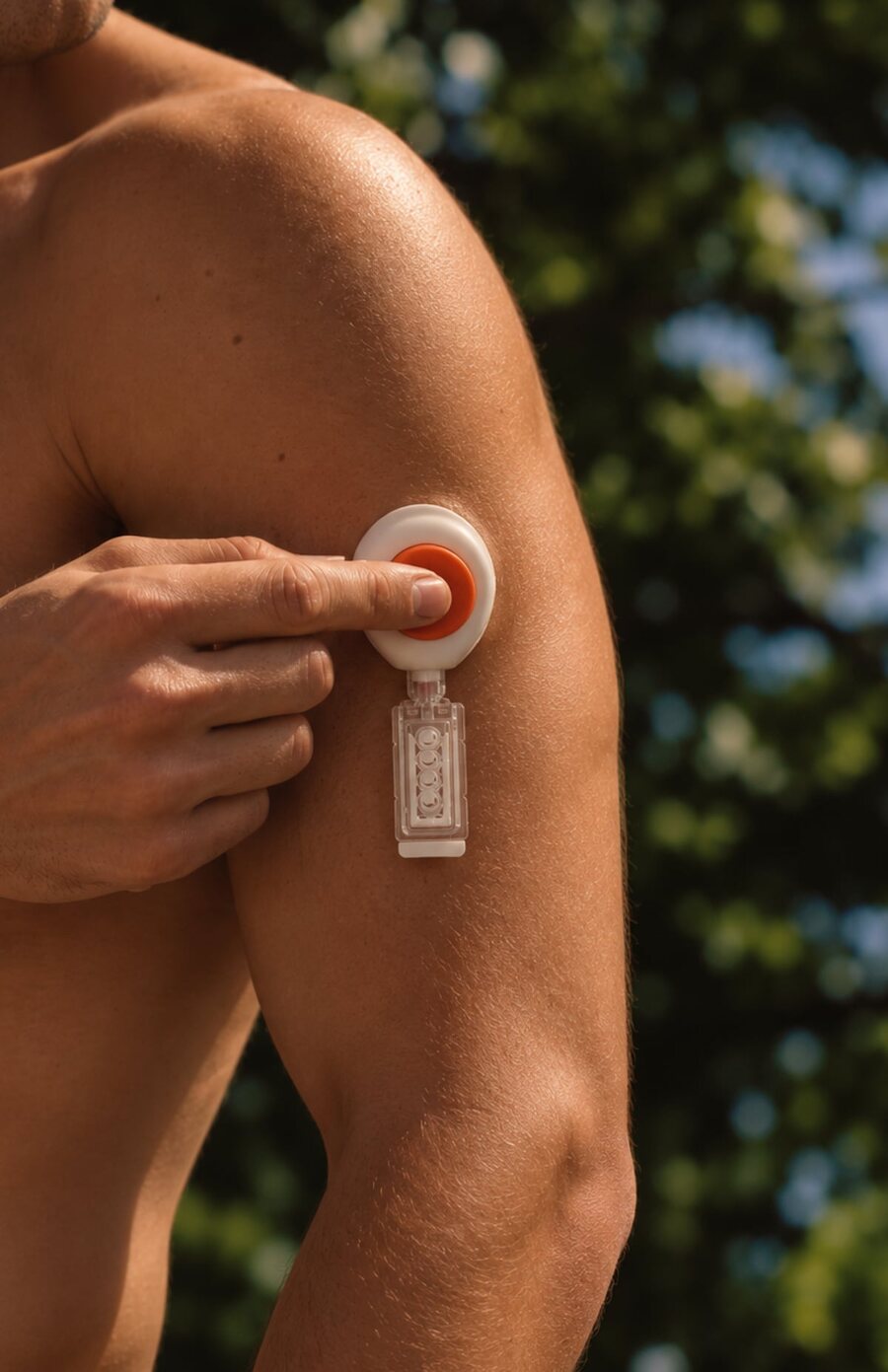
| Device | HeliosOne upper-arm lancet device collecting about 70 microliters onto four pads; samples stable a week at room temperature. | Company-stated |
| Product claims | About 1,000 proteins across 14 body systems; 71 age and risk scores; 200+ diseases predicted; scores support clinical judgment and are not diagnoses. | Company-stated |
| Validation | Side-by-side match with venous draws; all 71 scores predicted disease and death in an independent 40,000-person cohort on a different platform; whole-body score predicted 20 of 23 common diseases. | Company-stated |
| AI agent | Knowledge graph from 70+ curated public datasets citing 80,000+ papers; every suggestion links to sources. | Company-stated |
| Clinical endorsement | Launch release quotes Daniel Kang, MD, of AEON on the need for proteomics in elite care. | Company-stated |
| Attention | Co-founder’s launch post on X passed 700,000 views within hours. | Public post |
| Team | Five employees on YC; founders are Harvard Medical School faculty and an MGH physician. | Public record |
| Founder count and prior capital | Two founders and $400M+ on YC; three founders and $700M+ in the release. | Conflict |
| Published evidence | No peer-reviewed paper or preprint yet behind the validation claims above. | Gap |
The Diligence Question That Matters Most
Every landmark proteomics study used venous plasma processed under research conditions. A 2024 study in Proteomics compared Olink measurements from venous blood with capillary blood self-collected using the Tasso+ device in 20 volunteers, and found that only 14.8 to 29.6 percent of 230 proteins agreed well with venipuncture, depending on shipping time. The authors recommended limiting home self-collection to proteins with proven agreement. Helios says its own side-by-side testing found its device measured as many proteins as a venous draw at closely matching levels, and that its models are trained on device samples. Its founders built Sherlock on making lab chemistry work in disposable formats, so the claim is credible, but until the company publishes concordance data across its full panel, investors and clinicians are relying on an internal result.
What to Watch
- Publication of the side-by-side device data and the 40,000-person validation, with the number of proteins that pass.
- CLIA validation, which the company expects in the first quarter of 2027.
- Disclosure of the assay platform and a retail price, which together set gross margin.
- A priced round after the Fall 2026 Demo Day, and whether a diagnostics or consumer health specialist leads it.
- Which of the 15 named clinics go live first, at what price, and how the physician review model handles state licensure.
- Data rights terms for the longitudinal dataset, the asset that would justify a platform valuation.
- Competitive response from Function Health, Superpower or InsideTracker adding proteomic panels.
The Helios science and consumer review on Healthcare DiscoveryHealthcare Discovery
Related Companies
Sources
- Public recordSEC EDGAR full text search, Form D, no Helios Intelligence filing
- Public recordY Combinator company and founder pages, Helios Intelligence
- CompanyHelios Comes Out of Stealth, Reading 1,000+ Biomarkers to See Decades Into the Future of Your Health
- CompanyHelios homepage, FAQ, About and What We Measure pages, myhelios.com
- IndependentYC-backed startup Helios uses AI to predict health risks from a single drop of blood
- IndependentFormation firm profile, stage and check size
- IndependentOraSure Technologies acquires Sherlock Biosciences
- IndependentTome Biosciences to lay off 131 employees
- IndependentFunction Health $450M growth financing; 500,000+ members; $2.5B Series B valuation
- IndependentSuperpower and Neko Health financing context
- IndependentUS direct-to-consumer laboratory testing market estimates, 2026
- IndependentWhy Arivale failed: inside the surprise closure of an ambitious scientific wellness startup
- IndependentOh HS, et al. Organ aging signatures in the plasma proteome track health and disease. PMID 38057571
- IndependentCarrasco-Zanini J, et al. Proteomic signatures improve risk prediction for common and rare diseases. PMID 39039249
- IndependentEl-Sabawi B, et al. Capillary blood self-collection for high-throughput proteomics. PMID 38783781
- Public recordAmerican Clinical Laboratory Association v. FDA, LDT final rule vacated
Compiled from SEC public records, company materials and published reports as of November 20, 2026. Form D notices report offerings under Regulation D; a company that raises under other exemptions or on instruments not yet noticed files none, so the absence of a Form D is not evidence that no capital was raised. Revenue estimates for comparable companies are Healthcare Venture Capital Fund calculations from reported figures. Healthcare Venture Capital Fund holds no position in Helios. This page is not an offer to sell or a recommendation to buy any security.